Qamar Exports Sublimation Printing Guide for High-Performance Sportswear Apparel Manufacturing
Sublimation printing has transformed how technical sportswear, activewear, and modern fashion are manufactured. When executed correctly, it integrates vibrant, high-definition designs directly into the DNA of the fabric. However, for many apparel startups, distributors, and B2B wholesalers, navigating the transition from digital design to physical garment results in faded colors, banding defects, and mismatched sizing.
At Qamar Exports we have spent over 9 years mastering the physics and precision of sublimation. Having produced over 500,000 sublimated garments out of Sialkot, Pakistan, we follow EU Quality Standards and we use with eco-friendly ink for our products. we have streamlined our vertically integrated facility to handle every stage in-house: from digital pattern making and precision laser cutting to high-density heat transfer, stitching, and multi-stage quality control.
This guide breaks down the technical realities of industrial sublimation, exposes common manufacturing shortcuts, and outlines how we manage consistency at scale.
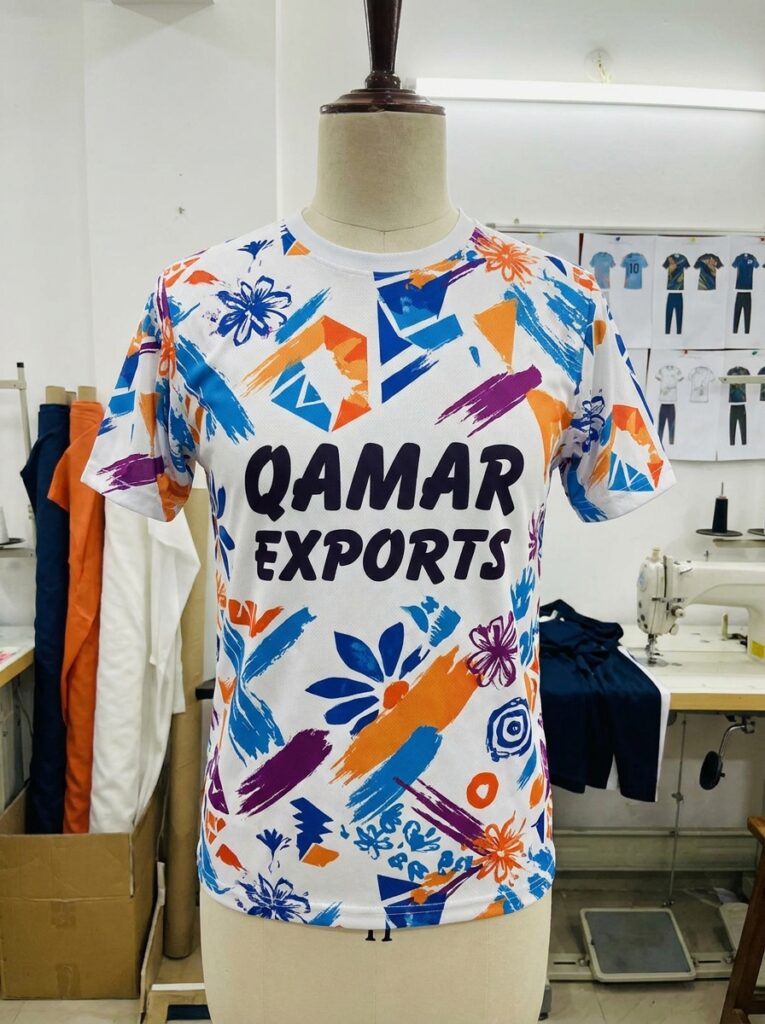
The Technical Anatomy of Premium Sublimation | Sublimation Printing Guide
Industrial sublimation relies on a precise thermodynamic reaction where solid dye particles turn into gas under intense heat and pressure, instantly bonding with the synthetic polymer fibers of the fabric.
Why Sublimation Fails with Low-Cost Manufacturers
Many buyers optimize strictly for the lowest per-unit price, unaware of where cut-rate factories trim their margins. Low-cost manufacturers routinely sacrifice final product integrity by using:
- Low-Density Inks: Cheap inks lack the pigment load required for deep blacks and rich gradients, leaving the garment looking washed out when stretched.
- Inferior Transfer Paper: Low-grade paper fails to release the full ink volume during pressing, causing inconsistent color depth across large panels.
- Underpaid, Inexperienced Labor: Sublimation machines do not run themselves. Unskilled operators misalign panels on the heat press, leading to devastating defects.
Common Production Defects & Root Causes
In a standard production environment, three primary issues frequently compromise quality. Understanding their technical roots is how we eliminate them before garments reach the cutting table:
| Defect | Visual Indicator | Root Cause in Production |
| Color Mismatch | Digital design colors do not match the physical fabric. | Incorrect ICC (International Color Consortium) color profiles or failing to calibrate printheads to specific fabric GSM. |
| Uneven Transfer | Splotchy patches, lighter areas, or fading near seams. | Uneven heating element calibration or fluctuating pressure across the flatbed industrial press. |
| Banding | Distracting horizontal or vertical lines running through solid colors. | Clogged nozzles or micro-misalignments in the printer’s media feed advancement system. |
Fabric Selection & Technical Specifications
Sublimation requires polyester or high-polyester blends because synthetic polymer molecules open up under high temperatures (180°C to 210°C / 356°F to 410°F) allowing the gasified dye to permanently penetrate the fiber matrix.
- Sportswear & Team Uniforms: We recommend 100% interlock polyester or bird-eye mesh ranging from 140 GSM to 180 GSM for optimal breathability and structural strength.
- Activewear & Compression Wear: High-performance compression requires a blend of 80-85% Polyester and 15-20% Elastane (Spandex) at 220 GSM to 280 GSM. This ensures maximum stretch without causing “grinning”—the white backing of the fabric showing through the print during heavy extension.
- Fashionwear & Hoodies: For premium streetwear hoodies, we utilize heavy-knit polyester fleece (300 to 350 GSM) with a brushed interior, ensuring a soft hand-feel without degrading print clarity.
2. Sublimation vs. DTF (Direct-to-Film): When to Choose Which
While Qamar Exports is a diverse manufacturer capable of utilizing multiple embellishment techniques, clients often confuse sublimation with Direct-to-Film (DTF) printing. Both have specific use cases depending on fabric composition and design placement.

Choose Sublimation For: True all-over prints (AOP), team uniforms, and high-intensity sportswear. Because the ink becomes part of the fiber, it adds zero weight to the garment, leaves the fabric fully breathable, and will never crack, peel, or fade over time.
Choose DTF For: Cotton apparel, dark heavy-blend hoodies, or small, localized logos where the design needs to sit sharply on top of the fabric texture. DTF is ideal for streetwear lines that prioritize cotton textures but still require high-color graphic flexibility.
Pre-Production Engineering: Artboards to Tech Packs
The single biggest bottleneck in apparel manufacturing is inadequate artwork preparation. Beginners frequently submit low-resolution .jpg mockups or vague reference images, which stalls the pattern-making department.
Vector Requirements & Sizing Control
To convert your digital design into a physical garment without pixelation or proportion distortion, our design wing enforces strict file criteria:
- Format: Master files must be submitted in fully editable vector formats: Native Adobe Illustrator (
.AI), Encapsulated PostScript (.EPS), or vector-based.PDFfiles. - Resolution & Color Space: All embedded raster elements must be at least 300 DPI scaled at 1:1 physical size. Designs must be mapped using the CMYK color profile, or matched to specific Pantone Matching System (PMS) codes to guarantee exact color replication on the press.
- The Scaling Trap: A common mistake inexperienced brands make is creating one master graphic and scaling it uniformly across all sizes. An all-over print that looks perfectly proportioned on a Medium jersey will wrap awkwardly around the flanks of a 2XL or cut off essential logos on a Small. At Qamar Exports, we adjust and re-tile the vector artwork separately across individual digital patterns for every size in your tech pack before printing.
The Qamar Exports Production Lifecycle
We do not outsource critical segments of your order. Our end-to-end infrastructure ensures that the exact specifications approved during the sampling phase are carried out through bulk production.
1.Tech Pack & Pattern Engineering: Establishing accurate structural files.
Our design team translates your artwork into digital grading patterns. We produce a comprehensive technical blueprint detailing stitching types, panel dimensions, and precise print placements.
2.Fabric Selection & Precision Laser Cutting: Eliminating jagged edges and uneven panel sizing.
The roll of raw, unprinted white polyester fabric is inspected and laid out. Using automated laser cutting machinery, we slice the individual panels of the garment with millimeter precision, preventing fabric warping during the assembly phase.
3.High-Speed Digital Printing: Transferring vectors to specialized sublimation paper.
Your approved vector files are sent to our high-resolution wide-format industrial printers. The designs are printed in reverse onto premium high-release sublimation transfer paper using high-density, rich-pigment inks.
4.Thermodynamic Heat Transfer: Fusing the dye into the fabric panels.
The printed transfer paper and the cut fabric panels are aligned perfectly on our industrial flatbed heat presses. Subjected to uniform pressure and constant temperatures exceeding 190°C (190 degrees Celsius)., the ink sublimates directly into the polyester fibers.
5.Precision Stitching & Assembly: Industrial sewing lines engineered for durability.
Sublimated panels move to our sewing floors. Depending on the garment type, we utilize 4-needle 6-thread flatlock stitching for high-stress activewear, or precise overlock seams for fashion apparel, ensuring structural longevity.
6.Multi-Stage Quality Control & Packing: Strict visual and measurement verification.
Every finished garment undergoes exhaustive QC checks. We verify panel-to-panel color consistency, inspect seam strength, check final measurements against the grading chart, remove loose threads, and individually steam-pack the order for international freight shipping.
Transparent Timeline Realities
We maintain a realistic approach to scheduling. While our internal record for rushing an urgent custom sample is 3 days, standard operational timelines are structured as follows:
- Sampling Phase: 7 to 14 days (includes pattern layout, test-printing, fabric sourcing, and physical assembly).
- Bulk Manufacturing Production: 20 to 45 days, depending on the scale of the order, design complexity, and seasonal volume on our floor.
Working Internationally: A Grounded B2B Perspective
Navigating apparel procurement from Pakistan does not require complex corporate structures, but it does require clear alignment on what matters.
Sourcing Realities & Practical Security
Many new brands place immense emphasis on finding facilities with expensive, superficial corporate certifications that don’t translate to real-world performance on the manufacturing floor. As an agile, growing manufacturer in Sialkot, Qamar Exports does not hide behind useless corporate paperwork. Instead, we anchor our reliability on verifiable transparency:
- A Solid Digital Footprint: We maintain a verified website, public business registration, and an active online presence showcasing real, ongoing work.
- Proof Before Production: We never ask you to trust blind promises. We provide comprehensive digital pre-production proofs and physical sampling validation. If an issue occurs during production—such as a minor fabric delay—we do not cut corners to catch up. We halt, provide the client with visual proofs, and restart the process properly rather than passing defective work down the line.
Experienced buyers understand this immediately. They come prepared with clear tech packs, ask direct structural questions, approve samples efficiently, and move straight to secure bank or commercial payments. Inexperienced buyers often focus on the wrong metrics, run into unnecessary panic, and sacrifice product quality by aggressively squeezing the budget below real manufacturing costs.
Ready to Streamline Your Apparel Supply Chain?
Whether you are scaling a gym brand, distributing bulk activewear, or launching a premium sportswear line, your manufacturer’s technical precision dictates your brand’s reputation. Let’s eliminate the guesswork from your next production run.